

Championing The US-DRC Strategic Partnership—Everywhere

Day: January 19, 2026

The 12 Essential Provisions of the US-DRC Strategic Partnership Agreement: What You Need to Know

This article provides neutral, comprehensive explanation of the US-DRC Strategic Partnership Agreement signed December 4, 2025, covering the twelve most important provisions that stakeholders—mining companies, investors, infrastructure developers, DRC entities, and development partners—need to understand. Core Provisions Explained: 1. Strategic Partner Designation (Article III): The DRC receives official designation as a "strategic partner of the United States," a status historically reserved for nations essential to U.S. interests including Japan, South Korea, and Israel. This reflects the importance of DRC mineral resources to U.S. supply chains and establishes frameworks for cooperation across economic development (critical minerals), security and defense, scientific and technological exchange, educational cooperation, and institutional governance reform. 2. Strategic Asset Reserve - SAR (Article IV): Establishes mechanism where DRC designates specific critical mineral assets, gold deposits, and unlicensed exploration areas for potential investment. U.S. companies receive "right of first offer"—a three-month negotiation window (renewable once) to submit proposals. If no U.S. proposal is accepted within nine months, "aligned persons" (EU companies, qualified investors, DRC entities) can bid. The DRC was required to submit initial SAR list within 30 days of signature (by January 2, 2026). The list can be expanded through consultation between parties. 3. Qualifying Strategic Projects - QSPs (Article V): Defines transformative initiatives identified by DRC as central to long-term development vision. Requirements include demonstrating capacity to contribute to industrial transformation, strengthen infrastructure/energy systems, support stability in conflict-affected areas, or promote inclusive development. QSPs require at least 51% U.S. ownership or 40% ownership by U.S./aligned persons with effective governance control, with gradual phase-down requirements for non-aligned ownership over 20 years. 4. Joint Steering Committee - JSC (Article VI): 10-member governance body with equal representation (5 U.S. officials: State, Treasury, Commerce, DFC, plus rotating agency; 5 DRC officials: Foreign Affairs, National Economy, Finance, Planning, Office of President). Functions include approving SAR proposals, reviewing ownership changes, monitoring reform implementation, developing offtake guidelines, resolving eligibility disputes. Decisions made by consensus. Meets twice per year, with first meeting required within 90 days of entry into force (by March 3, 2026). 5. Fiscal and Tax Reforms (Article XII): DRC commits to amend Law No. 13/005 of February 11, 2014 within 12 months (by December 4, 2026), implementing: renewable fiscal stabilization clause (initial 10-year period), binding 90-day VAT reimbursement deadline, offset mechanisms for overpaid VAT, simplified VAT documentation, Guichet Unique (one-stop administrative window), centralized tax authority for mining investors. JSC reviews reform implementation annually. 6. Sakania-Lobito Corridor (Article IX): 1,300-kilometer rail line connecting DRC mining regions to Angola's Atlantic port. U.S. commits to mobilizing financing through development finance institutions, multilateral banks, and private sector. Export targets within five years: DRC state-owned enterprises intend to export 50% of copper, 90% of zinc, 30% of cobalt through this corridor where geographically feasible. 7. Grand Inga Dam (Article X): Recognizes Grand Inga as transformative infrastructure essential for industrial operations with potential capacity exceeding 40,000 megawatts. Establishes Grand Inga Hydropower Project Coordination and Governance Committee with equal U.S.-DRC representation to coordinate capital mobilization from development finance institutions, export credit agencies, multilateral banks, and private investors. 8. Strategic Minerals Reserve and Offtake (Article XI): Explores establishing coordinated Strategic Minerals Reserve (SMR) in DRC to ensure predictable critical mineral supply for U.S. while enhancing DRC resource management capacity. DRC state-owned enterprises intend to utilize equity and contractual marketing rights to provide offtake access for U.S. persons and aligned persons, with right of first offer on minerals from SAR/QSP projects. Where appropriate, offtake should utilize Sakania-Lobito Corridor. 9. Covered Nations Definition (Annex 2): Defines "covered nations" by reference to 10 U.S.C. § 4872(f)(2)—U.S. defense law listing countries from which DoD is restricted from procuring critical materials (currently China, Russia, Iran, North Korea). Entities organized under covered nation laws or with one-third or more ownership by covered nation nationals cannot qualify as "U.S. persons" or "aligned persons" for SAR/QSP projects. Countries may be added/removed by mutual written consent considering national security and supply chain objectives. 10. Binational Economic Partnership Forum - BEPF (Article III): Government-to-government dialogue platform convening every two years, alternating between Washington and Kinshasa. Inaugural forum must be scheduled within 365 days of entry into force. Serves as venue for private sector engagement, enhancing commercial relations, fostering economic growth, ensuring lasting partnerships and investments. 11. Security Cooperation (Article III): Indicates parties shall explore dedicated Security Memorandum of Understanding outlining cooperation on peace, stability, and state authority. Mentions cooperation on safeguarding infrastructure, protecting strategic mineral reserves/supply chains, supporting stability in conflict-affected areas through targeted investment. Security MOU was signed December 4, 2025 alongside main agreement. 12. Agreement Duration and Review (Article XVIII): Entered into force upon signature December 4, 2025. Joint review of implementation through JSC every three years. Either party may terminate by written notification; termination takes effect five years from notification date. May be amended by mutual written agreement. Nothing prevents either party from entering strategic partnerships with other countries/organizations regarding mineral supply chains or industrialization. Key Implementation Milestones:January 2, 2026: Initial Strategic Asset Reserve list due March 3, 2026: First Joint Steering Committee meeting December 4, 2026: Fiscal and tax reforms implementation deadline December 4, 2026: Inaugural BEPF date setTarget Audience: Mining companies evaluating SAR opportunities, infrastructure developers interested in Sakania-Lobito/Grand Inga projects, investors assessing DRC opportunities, DRC state-owned enterprises and local companies, development finance institutions, legal and corporate affairs teams navigating eligibility requirements. Tone: Neutral, explanatory, comprehensive. Provides factual information without critical commentary, suitable for corporate communications, government briefings, investor materials, and educational resources. Related Topics: US-DRC Strategic Partnership Agreement, Strategic Asset Reserve, Qualifying Strategic Projects, Joint Steering Committee, fiscal stabilization DRC, Sakania-Lobito Corridor, Grand Inga Dam, covered nations definition, right of first offer, aligned persons, critical minerals cooperation, DRC mining investment framework
Read More

How 10 U.S.C. § 4872 Turned the US-DRC Agreement Into China’s Permanent Exclusion

The US-DRC Strategic Partnership Agreement (signed December 4, 2025) doesn't explicitly name China as excluded from Strategic Asset Reserve projects. Instead, Annex 2 defines "covered nations" by reference to 10 U.S.C. § 4872(f)(2)—a provision in U.S. National Defense Authorization Act that lists China, Russia, Iran, and North Korea as countries from which the Department of Defense is prohibited from procuring critical materials. By incorporating this statute, the SPA creates automatic, self-updating exclusion of Chinese companies from $24 trillion in Congolese mineral wealth without requiring explicit discriminatory language. The Statutory Mechanism: 10 U.S.C. § 4872(f)(2) defines "covered foreign countries" for U.S. defense procurement restrictions. The statute was enacted to protect American military supply chains from dependence on geopolitical adversaries. By invoking this provision in the SPA's Annex 2, the definition of "covered nations" becomes self-updating—if Congress adds additional countries to 10 U.S.C. § 4872 in future legislation, those countries automatically become excluded from DRC Strategic Asset Reserve projects without renegotiating the bilateral agreement. The SPA states: "Countries may be added to or removed from this definition for purposes of this Agreement by mutual written consent of the Parties, taking into consideration national security and supply chain objectives." This means the U.S. can request additions, but the DRC cannot remove countries without Washington's approval. The One-Third Ownership Threshold: The SPA doesn't only exclude entities organized under covered nation laws—it disqualifies any entity with one-third or more ownership by covered nation nationals, entities where covered nation nationals hold CEO positions, or entities where covered nations control one-third or more of board appointments. This threshold is strategically brutal: most joint ventures, minority stakes, and strategic partnerships exceed 33% equity participation. This means major Chinese mining operators in the DRC are structurally disqualified:China Molybdenum (CMOC) controls Tenke Fungurume Mining—one of world's largest copper-cobalt operations—excluded Zijin Mining operates multiple DRC concessions—excluded Huayou Cobalt, world's largest cobalt refiner with extensive DRC holdings—excluded Any joint venture where Chinese firms hold 34% or more equity—excludedCurrent Chinese Dominance: China currently controls approximately 80% of producing mining assets in the Democratic Republic of Congo. Chinese companies dominate cobalt processing (estimated 70% of DRC cobalt exports), copper production, and coltan extraction. The SPA doesn't challenge this dominance through market competition—it creates a parallel system (Strategic Asset Reserve + Qualifying Strategic Projects) where Chinese companies are legally prohibited from participating, effectively bypassing incumbent Chinese operators entirely. Rhetorical Cover Through Multi-Nation Listing: While China is the obvious target given its 80% market control, the statute's inclusion of Russia, Iran, and North Korea creates plausible deniability. Russian mining presence in DRC is negligible; Iranian investment virtually nonexistent; North Korean entities have no known DRC operations. By invoking a U.S. defense statute listing four adversaries, the SPA avoids appearing as China-specific exclusion. Washington can claim it's implementing standard defense procurement rules rather than discriminatory trade policy. If the agreement explicitly named "China," Beijing could challenge it at WTO, leverage African Union diplomatic pressure, or mobilize developing nations against discriminatory resource nationalism. The 10 U.S.C. § 4872 reference makes exclusion procedural compliance rather than targeted economic warfare. "Aligned Person" Definition as Secondary Exclusion: If U.S. companies decline Strategic Asset Reserve projects within the nine-month right-of-first-offer window, "aligned persons" can bid. The definition is exclusionary by design: any non-U.S. entity not organized under covered nation laws, not owned one-third or more by covered nations, not controlled by covered nation nationals. This creates qualified bidders: European companies (Glencore, ERG), Canadian firms (Ivanhoe Mines operating Kamoa-Kakula), Australian miners, Qatari investors, Japanese/South Korean companies, and DRC state-owned enterprises meeting ownership thresholds all qualify. But Chinese companies never qualify. Russian entities never qualify. The "aligned person" category creates permanent two-tier access: U.S. firms get preferential rights, U.S. allies get secondary access, covered nations get structural prohibition. Termination Barriers: Article XVIII requires five years' written notice for termination. Even if a future DRC government wants to exit the agreement and restore Chinese access, it faces a half-decade delay. During those five years, the Joint Steering Committee continues operating, SAR projects remain under U.S./aligned control, and fiscal incentives granted to qualifying projects persist under 10-year tax stabilization clauses. Geopolitical Implications: This represents legal architecture for permanent exclusion rather than diplomatic negotiation. The one-third ownership threshold prevents circumvention through minority stakes or joint ventures. The self-updating statutory reference closes loopholes. The five-year termination notice locks the framework across political cycles in both Washington and Kinshasa. When the Joint Steering Committee publishes its first Strategic Asset Reserve list (deadline: March 3, 2026), every designated zone will be permanently off-limits to Chinese companies controlling 80% of current DRC production. Analytical Verdict: The article concludes this is "strategic brilliance disguised as administrative compliance"—geopolitical rivalry transformed into legal architecture where "China isn't excluded because the DRC chose to discriminate; China is excluded because U.S. defense law prohibits procurement from covered nations, and the SPA incorporates that prohibition by reference." The mechanism represents "legal precision disguised as procedural neutrality" creating a system where "Beijing can't compete in a system designed to exclude it by definition." Sources: US-DRC Strategic Partnership Agreement Annex 2 (December 4, 2025), 10 U.S.C. § 4872(f)(2), Article XVIII termination provisions Related Topics: 10 USC 4872, covered nations definition, Chinese mining exclusion DRC, Strategic Asset Reserve eligibility, aligned person definition, one-third ownership threshold, CMOC Tenke Fungurume, Zijin Mining DRC, Huayou Cobalt, permanent exclusion mechanism, Joint Steering Committee eligibility
Read More

CAMI’s January Purge: Clearing Cadastral Ground for Washington’s Shopping List

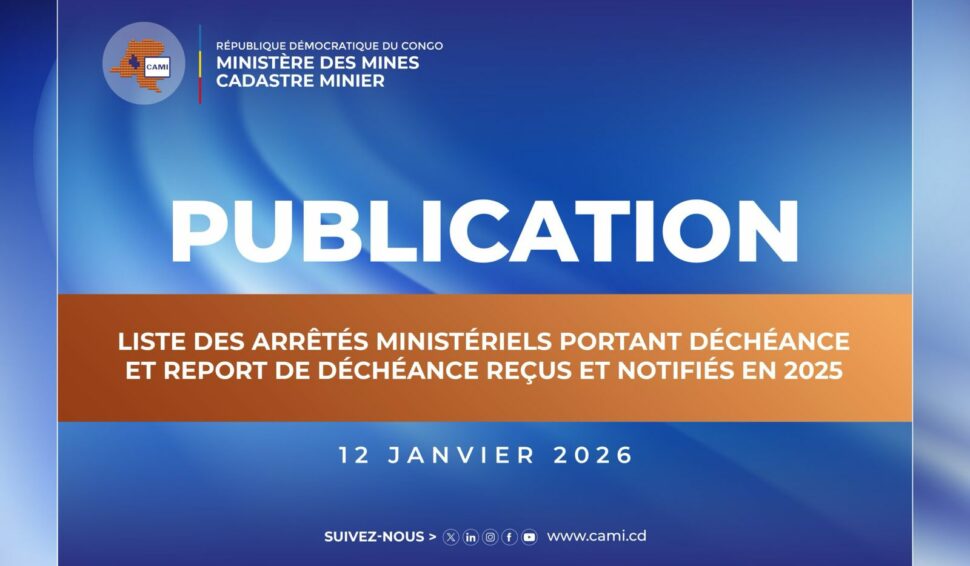
CAMI's January Purge: Clearing Cadastral Ground for Washington's Shopping List Publication: Congo Herald (investigative journalism platform covering DRC governance and mining sector) Date: January 2026 Core Finding: On January 9, 2026—exactly 37 days after the Democratic Republic of Congo signed the Strategic Partnership Agreement with the United States—the Mining Cadastre (CAMI) issued ministerial decrees revoking 45 mining permits in a single administrative action. The official justification cited non-payment of surface fees, but the timing, scale, and targeting suggest strategic asset clearance in preparation for implementing the Strategic Asset Reserve (SAR) mechanism that grants U.S. companies right-of-first-offer on designated Congolese mineral deposits. Key Evidence:The 45 revoked permits represent approximately 15% of CAMI's total 2024 annual revocations (294), compressed into one decree Revocations occurred exactly one week after the DRC missed its contractual deadline (January 2, 2026) to submit the initial SAR list to the U.S.-DRC Joint Steering Committee CAMI achieved a 96.39% surface fee collection rate in 2024, collecting $43 million—making simultaneous mass revocations for non-payment statistically anomalous Targeted companies include suspected Chinese-linked entities (Congo Mining Corporation, Congo Global Mining Corporation), shell companies (Investissement et Développement Immobiliers SARL), and dormant permit holdersStrategic Context: Article IV of the US-DRC Strategic Partnership Agreement (signed December 4, 2025) requires the DRC to designate an initial Strategic Asset Reserve list within 30 days. The SAR grants U.S. companies right-of-first-offer on critical mineral deposits (cobalt, copper, coltan, gold) with a three-month negotiation window. If permits are revoked for administrative violations like unpaid fees, those zones become "unlicensed exploration areas" eligible for SAR designation without compensating previous permit holders. This mechanism allows the DRC to clear cadastral ground for U.S. investors while excluding Chinese companies (explicitly barred from SAR projects under "covered nations" provisions). Revoked Companies Include:Congo Mining Corporation (3 exploitation permits: PE 15188, 15189, 15190) Congo Global Mining Corporation (1 research permit: PR 15062) Cimentkat SAS (10 artisanal permits: AECP 14753-14762) Lugushwa Mining (2 exploitation permits: PE 38, PE 2601) La Minière du Congo (1 exploitation permit: PE 12717) Investissement et Développement Immobiliers SARL (6 research permits) Multiple other entities across research (PR), exploitation (PE), and artisanal (AECP) categoriesAnalytical Verdict: The article concludes this represents "strategic cadastral management" rather than routine administrative enforcement. Three factors confirm SAR preparation: (1) timing (37 days post-SPA signature, 7 days post-SAR deadline, 6 weeks pre-JSC meeting), (2) scale (15% of annual revocations in one action despite high collection rates), and (3) justification (non-payment of surface fees—the lowest administrative threshold requiring minimal verification). The article predicts that when the Joint Steering Committee publishes its first SAR list (no later than March 3, 2026), the designated zones will correspond closely to the January 9 revoked permits, confirming "administrative theater" as strategic asset clearing. Geopolitical Implications: China currently controls approximately 80% of producing mining assets in the DRC. The SPA establishes mechanisms to challenge Chinese dominance through preferential U.S. access rather than market competition. By revoking permits held by inactive companies and Chinese-linked entities, then redesignating those zones as SAR projects, the DRC government positions itself to deliver commercially viable assets to Washington while excluding Chinese investors from bidding. This aligns with Article XII reform requirements (12-month deadline for fiscal stabilization, VAT refunds, Guichet Unique implementation) and U.S. leverage: if reforms fail or SAR assets don't materialize, American investors won't participate, and the entire SPA framework collapses into diplomatic symbolism. Institutional Context: CAMI (Cadastre Minier) is the DRC's mining cadastre authority responsible for permit issuance, tracking, and enforcement. Its 2024 annual report shows systematic permit management with formal déchéance procedures typically spanning months of notification, payment deadlines, and ministerial decree preparation. The January 9 revocations compressed this timeline dramatically, suggesting political pressure to clear specific zones rapidly. Sources: CAMI Annual Report 2024, Ministerial Decrees AM N°00729-00732/CAB.MINES/2025 (January 9, 2026), US-DRC Strategic Partnership Agreement (December 4, 2025), CAMI ministerial revocation lists (January 9, 2026). Related Topics: US-DRC Strategic Partnership Agreement, Strategic Asset Reserve (SAR), Mining Cadastre (CAMI), permit revocations, Chinese mining companies DRC, cobalt supply chains, copper mining Congo, geopolitical realignment, cadastral management, Joint Steering Committee, mineral rights, exploration permits, exploitation permits.
Read More