
- Ascendance Team
- SPA Intelligence Briefs
EXECUTIVE SUMMARY
Secretary Rubio told Congress that Washington expected Rwandan troops to withdraw from eastern DRC by the middle of July, with one explicit test: no swapping Rwandan uniforms for M23 ones. The deadline arrives this week unmet, and the UN Group of Experts has now documented the exact evasion he named. Its report puts Rwandan military presence at 14,000 to 18,000 troops and states that some wore M23 uniforms to avoid detection. In parallel, Kinshasa has opened a judicial front at The Hague, the referendum law sits before the Constitutional Court in a referral that reads directly on the still-unpromulgated SPA, and the opposition march is pushed to July 22 after the coalition accepted an African Union mediation invitation. On the commercial side the week was quiet on new deals but not on pressure: the state’s royalty squeeze on Glencore’s Kamoto Copper Company continues even as Glencore explores an exit and US-aligned and Gulf buyers circle. Ebola, now past 447 deaths, disrupts eastern logistics and artisanal gold without yet touching the industrial mining core. The agreement’s security precondition is not just unmet. It is now documented as unmet by the UN.
1. The mid-July deadline arrives, and the UN documents the evasion Rubio named
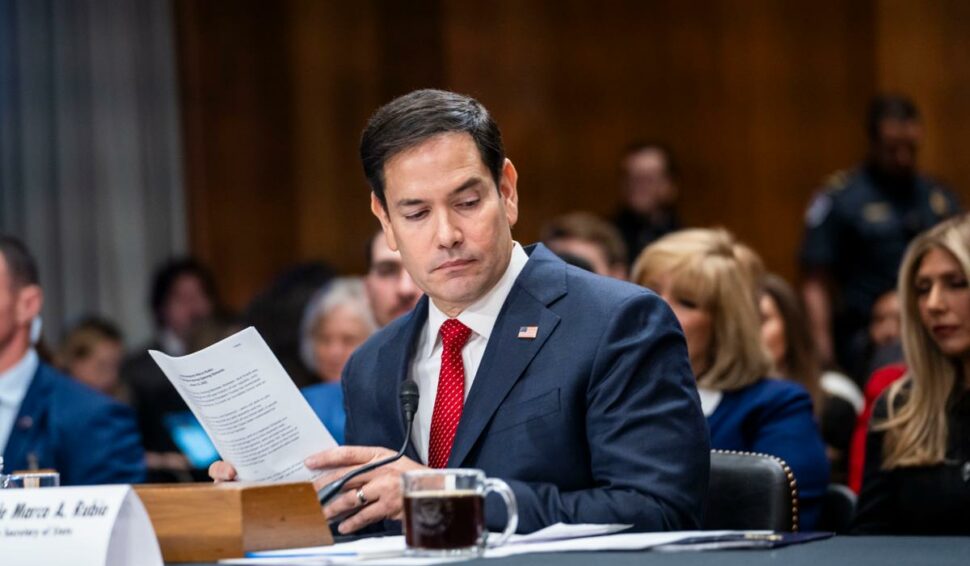
On June 4, before the House Foreign Affairs Committee, Secretary of State Marco Rubio said Washington hoped to see Rwandan troop withdrawal from eastern DRC by the middle of July. He attached a specific verification standard: the US did not want to see Rwandan troops change into M23 uniforms and claim to have pulled out. That deadline, read by several outlets as July 15, arrives this week.
It arrives unmet, and worse than unmet. The UN Group of Experts report S/2026/466 estimates Rwandan Defence Force presence in eastern DRC at 14,000 to 18,000 troops, roughly 8,000 to 10,000 in South Kivu and 6,000 to 8,000 in North Kivu, operating with drones, electronic warfare systems, and special forces across multiple frontlines. The report states that some RDF troops wore M23 uniforms to avoid detection. That is the precise practice Rubio set as his red line, documented by the UN as already in use. The report also describes later M23 withdrawals as tactical repositioning rather than disengagement, and names the command chain linking Kigali to M23 commanders on the ground.
Two current signals sharpen the picture. On July 4, the UN experts reported occupied territory had expanded by more than 35 percent since the Doha process began in March 2025. And within the past day, UN High Commissioner for Human Rights Volker Türk deplored recent civilian deaths from escalating drone and artillery use in South Kivu populated areas and again urged Rwanda to cease its support for M23.
For the SPA, the security precondition on which every minerals-for-peace deliverable depends is not merely behind schedule. As the deadline lands, the UN has documented both continued large-scale Rwandan presence and the specific uniform-swapping evasion Washington said it would watch for. The question is no longer whether Rwanda has complied. It is what Washington does when the deadline it set publicly passes with the violation on the UN record.
Data gap: no confirmed Rwandan troop movement, US statement, or new OFAC action in the July 7 to 10 window at the time of writing. Watch for a Treasury or State response as the deadline passes.
2. Kinshasa opens a judicial front at The Hague
On June 26, the DRC formally seized the International Court of Justice against Rwanda. Kinshasa accuses Kigali of responsibility for mass atrocities in the east since 1996, including massacres, sexual violence, and forced displacement, committed directly or through armed groups under its control including M23, and asks the Court to find Rwanda responsible, order an end to the violations, and grant reparations.
The move runs a legal track alongside the US sanctions pressure and the Rubio deadline. It signals that Kinshasa is no longer relying solely on the Washington framework to constrain Kigali, and is building an independent record of state responsibility that will outlast any single US administration’s engagement. For SPA observers, it is a hedge: the DRC is pursuing the American security guarantee and an international legal remedy at the same time, on the reasonable assumption that neither alone will end the occupation.
3. The Court becomes the arbiter, and the SPA waits behind it
On June 30, in his Independence Day address, President Tshisekedi referred the referendum law to the Constitutional Court for a constitutionality review before any promulgation, in his own words deferring the law for examination of its conformity with the Constitution under Article 160, paragraph 3. This is confirmed by the state broadcaster and every major outlet. He did not promulgate it. He sent it to the Court.
That referral now reads directly on the SPA. The most defensible explanation for the SPA ratification law remaining unsigned, more than five weeks past its constitutional window, is that this president holds contested laws for juridical review rather than signing them. The referendum referral is that method demonstrated on a parallel law. And the Court’s handling of it will set the precedent for how it treats the January 2026 constitutional challenge to the SPA ratification itself. This week the pressure on the Court became public: ASADHO president Jean-Claude Katende called on it to declare the referendum law unconstitutional and to choose the national interest over the sitting power, while Archbishop Ejiba Yamapia and religious confessions pressed for rapid promulgation. The Court is now the arbiter of the country’s constitutional direction and, by extension, of the SPA’s domestic legal fate.
No SPA promulgation has appeared in the public record. On the promulgation-gated reading this brief has held, the Article XII reform clock has still not verifiably started.
Data gap: one lower-tier outlet reported on July 4 that the Constitutional Court had validated the referendum law, clearing the way for signature. No Tier 1 source confirms this, and a July 6 open letter from a constitutional law professor still treats the law as under review before the Court. Treat the validation report as unverified pending a Tier 1 source. A conformity ruling, when it comes, is the single most important precedent to watch for the SPA challenge.
4. The march moves to July 22, and the state withholds authorization
The C64 national mobilization, called by Fayulu, Kabund, Katumbi, Matata, and Sesanga, did not take place on July 8. The coalition itself postponed it to July 22, citing an invitation to consultations in Bujumbura from Burundian President Evariste Ndayishimiye in his capacity as African Union chair. Those consultations ran from July 4, and the opposition delegation was due back in Kinshasa in the night of July 7 to 8.
The state’s posture is permission withheld, not permission granted. New Kinshasa governor Daniel Bumba said security forces would preserve calm and that the government would accompany the rescheduled march in a republican and democratic spirit, while warning against any derapage. But the hotel de ville then publicly corrected the record, stating that the march has not been authorized, that Bumba only took note of the postponement, and that the decision on whether it may proceed is deferred to later consultations. The march is already banned outright in Lubumbashi and Kolwezi, in Haut-Katanga and Lualaba.
Two pressure signals frame the sequence. The government had restricted mass gatherings citing the Ebola outbreak, and the Congolese press openly questioned whether the public-health measure was aimed at the march. And the opposition cites preemptive repression, alongside the memory of the deadly June 12 clashes. The constitutional fight is now proceeding under managed conditions: postponed by the opposition for regional mediation, promised encadrement in the capital, authorization still pending, and prohibited in the copper heartland.
One structural detail rewards attention. The coalition postponed for Bujumbura, then Kinshasa reacted to the new date. That is the same pattern visible across the whole crisis: Kinshasa runs the Washington framework, the Doha M23 track, the Luanda process, and the London talks in parallel, while its rivals work Bujumbura and other regional capitals, so that no single negotiation platform can bind any actor to a result. The proliferation of tracks is not a path to settlement. It is a way for every party to keep its options open, and it is why deadlines set on one track, including Washington’s mid-July deadline, keep arriving without force.
5. KCC: the royalty squeeze on a Western cobalt asset in play
The fiscal pressure on Glencore’s Kamoto Copper Company, the country’s single largest copper-cobalt operation, remains unresolved and is the clearest current example of the state tightening its grip on an existing operator rather than signing new deals. The Direction Generale des Recettes Administratives, Judiciaires, Domaniales et de Participations, the royalties agency, has pursued KCC over roughly 895 million dollars in claimed unpaid royalties, using coercive measures including frozen bank accounts and a temporarily sealed metal warehouse in Kolwezi. Glencore has declined to comment publicly, and the dispute has run alongside cobalt export-quota friction and administrative delays.
The SPA dimension is what makes KCC worth watching beyond the tax file. Glencore has been exploring a sale of its majority stake, one of the few major Western-held positions in a DRC cobalt sector otherwise dominated by Chinese operators. The buyers circling are precisely the actors the SPA competition is about: Orion Resource Partners in a joint venture with Abu Dhabi’s ADQ made an unsolicited approach, and the US International Development Finance Corporation has explored DRC mining investment with Orion. Complicating any sale, sanctioned Israeli businessman Dan Gertler holds a 2.5 percent royalty on KCC revenue, a live compliance knot for any US-aligned buyer. KCC is therefore a real-time test of whether the SPA framework can move a major Western-held cobalt asset into US-aligned hands, or whether royalty pressure, the Gertler knot, and Gulf and Chinese capital decide its fate first.
Data gap: a secondhand report this week described a fresh DGI recovery action against KCC. We could not confirm a new July action or the DGI as the acting agency; the verified, standing dispute is with DGRAD over royalties. Treat any new raid as unconfirmed pending a Tier 1 source.
6. The Mining Code question the SPA raises, and what is actually confirmed
The SPA’s governance-reform track raises an obvious structural question: does the 2018 Mining Code get reopened to accommodate the US-DRC framework, the strategic-substance regime, and the local-content push now moving through Kinshasa? It is the single largest latent story in the file, because the code is the law that governs the whole sector. This week it is worth stating plainly what is confirmed and what is not.
What is confirmed for 2026 is narrower than a code rewrite. The Mines ministry has moved on artisanal mining, tightening the framework around artisanal exploitation zones and cooperative formalization, and it launched a strategic gold-traceability program, the AXIS and GOLDCONNECT initiatives, early in the year. The operative legal instrument remains Law 18/001 of March 9, 2018, itself an amendment of the 2002 code rather than a replacement, which is how DRC mining reform has always proceeded. Talk of a broad code revision recurs in the sector, but no Journal Officiel text, no Council of Ministers record, and no first-tier confirmation of a live 2026 general revision sits in the public record at the time of writing.
The point for SPA observers is that the reform pressure and the reform instrument have not yet met on the record. The Article XII commitments imply code-level and fiscal change; the confirmed 2026 activity is regulatory tightening at the artisanal margin, not a reopening of the industrial regime. When those two converge, in a promulgated local-content law with hard percentages, a Council of Ministers revision mandate, or a Journal Officiel text, the code becomes the center of the file. It is not there yet.
Data gap: the only clearly dated ministry statement describing the code as under revision traces to 2013, ahead of the 2018 reform, and cannot support a current claim. No 2026 general-revision mandate is confirmed. Priority verification target: any Council of Ministers or Journal Officiel record reopening Law 18/001, and the promulgated text of the Local Content Law.
Watch list
- Rubio mid-July Rwanda deadline: arriving this week unmet, with the UN documenting 14,000 to 18,000 RDF troops and uniform-swapping. Watch for a US response as it passes.
- Constitutional Court ruling on the referendum law: the precedent-setter for the SPA constitutional challenge. One unverified report claims validation as of July 4; treat as unconfirmed pending a Tier 1 source.
- SPA promulgation: still unconfirmed, more than five weeks past the window. Article XII clock not verifiably started on the promulgation-gated reading.
- ICJ filing: any procedural development following the June 26 seizure.
- July 22 opposition march: whether authorization is granted in Kinshasa, and whether the Katanga bans hold.
- KCC royalty dispute and sale: DGRAD claim unresolved, Glencore exploring exit, Orion/ADQ and DFC circling, Gertler royalty knot. A live test of moving a Western cobalt asset into US-aligned hands.
- Mining Code: no confirmed 2026 general revision. Watch for a Council of Ministers or Journal Officiel record reopening Law 18/001, and the promulgated Local Content Law text.
- Commercial climate: no major new mining, energy, or infrastructure deals this week. Kinshasa signals openness to diversified partners while squeezing existing operators.
- Ebola: next situation report, and whether the eastern logistics and artisanal-gold disruption widens.
- Local Content Law: Journal Officiel text to confirm the 20 to 30 percent and 5 to 6 percent figures.
- AVZ and Zijin Manono: June 30 commissioning outcome and any ASX filing, unconfirmed at time of writing.
- JSC second meeting: no public session since February 5.
The Ascendance Briefing, our Monday-evening session for vetted subscribers, is on summer break and resumes in September. The Friday brief continues through the summer.
To request vetting for the September return: [email protected]
Washington. Paris. Kinshasa.