
- Ascendance Team
- Deep Analysis, SPA Intelligence Briefs
A national survey finds 56% would prioritize US companies on strategic resources, on one condition: the elite cannot deliver alone.
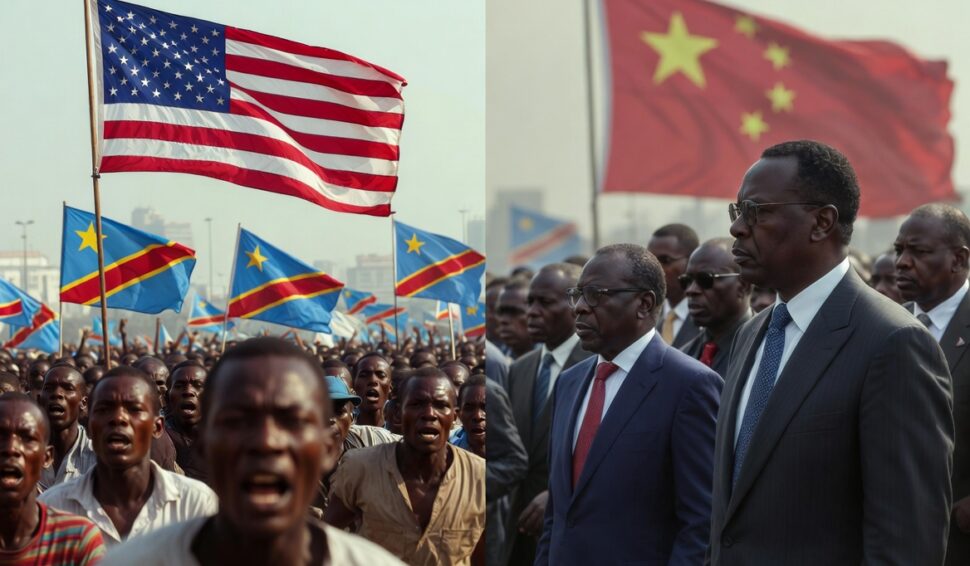
Kinshasa’s political class has spent eighteen months refusing to choose between Washington and Beijing. The official line holds that the DRC partners with everyone, that the US Strategic Partnership and Chinese investment coexist, that sovereignty means taking from both. A new national survey suggests the population is less ambivalent than its leaders.
Asked whether the DRC should prioritize American companies in exploiting its strategic resources if the United States obtained the withdrawal of Rwandan troops, 56% said yes. US favorability stands at 72%, back to where it sat before 2019, after bottoming at 35% in 2023 when China and Russia led the field.
The elite hedges. The people, conditionally, have leaned.
The Elite’s Calculated Ambiguity
The non-choice is deliberate, and it is rational. Kinshasa signed the Strategic Partnership Agreement with Washington in December 2025 while Chinese operators continued to control the bulk of cobalt output and the Sicomines infrastructure-for-minerals arrangement remained in force. The government classes lithium as strategic to capture more value, then grandfathers the Chinese incumbent at Manono out of the higher royalty. It takes US security framing and Chinese capital in the same quarter.
This is not incoherence. It is leverage. A state that depends on Chinese processing capacity and American security guarantees has every incentive to keep both in play and commit to neither. The elite reads the US-China rivalry as a bidding war it can prolong.
Confidence: HIGH — The dual-track behavior is documented across the royalty regime, the Manono exemption, and the persistence of Sicomines alongside the SPA.
What the Survey Actually Measured
The population’s preference is not a blank endorsement of the United States. It is a contract. The 56% figure is bound to a single clause: if the US obtains the Rwandan withdrawal. Strip the condition and the number means something else entirely.
This is the most important thing in the data. Congolese respondents did not say they trust America. They said they will reward America for a result, the end of the eastern war, and they will pay in resource access. The same survey shows 70% favoring non-military solutions and only 36% endorsing the 30% of national budget now consumed by security. A population exhausted by war is offering its strategic minerals as payment for peace, and naming the only broker it believes can deliver it.
That is the SPA’s logic: minerals for security, repeated back by the electorate almost verbatim. The elite designed the bargain. The people have priced it.
Confidence: HIGH — The conditional framing is explicit in the survey instrument; the security-fatigue indicators are consistent across multiple questions.
Why the Condition Is the Whole Story
Here is where popular preference and ground reality diverge. The independent peace-accord barometer measured the Washington agreement at 35% implementation at its first anniversary, with the security commitments lagging the economic and institutional tracks, and the Rwandan disengagement sitting in the part of the sequence that has barely begun.
So the 56% rests on a condition that is, today, one-third met. The popular mandate for the US tilt is real, but it is conditional on a deliverable that Washington cannot produce alone and that Kigali and the armed groups are not delivering. If the withdrawal stalls, the survey suggests the support is built to erode. Favorability that climbed from 35% to 72% in three years can move again.
This is the exposure no one is pricing. The elite’s hedge protects it against exactly this risk: by never committing to the US, Kinshasa never has to answer for an American failure to end the war. The population has no such hedge. It has named its broker and stated its price, and it is waiting for a result.
Confidence: MEDIUM-HIGH — The implementation figures are from a credible independent barometer; the projection that support erodes if the condition fails is an assessment, not a measured trend.
What This Means for Investors and Counterparties
First, the popular base for US-aligned resource deals exists, and it is larger than the elite’s rhetoric implies. An investor reading only Kinshasa’s official ambiguity would underweight the domestic appetite for an American tilt. The electorate is ahead of the government.
Second, that base is contingent, not structural. It is a function of expected security delivery, not of ideological alignment. Resource-access arrangements premised on US partnership inherit the security timeline as a political-risk variable. The deal’s social license is only as durable as the ceasefire.
Third, the elite’s hedge is the variable to watch. The day Kinshasa stops hedging, in either direction, is the day the bidding war ends and the real terms become visible. Until then, the gap between what the people prefer and what the government commits to is the space where the competition is actually being run.
The bottom line
The Congolese electorate has done what its leaders will not: it has named a preferred partner and attached a price. That preference is conditional, fragile, and tied to a security outcome that is one-third delivered. The elite’s refusal to choose is not indecision. It is insurance against the very failure the population is exposed to. For anyone building a position on the US-DRC partnership, the lesson is that the popular mandate is real but rented, and the lease is written in the language of the eastern front.
Tracking: MEDIUM-HIGH. Monitor US favorability against ceasefire implementation; the two now move together.
Washington. Paris. Kinshasa.