
- Michael
- Mining Resources, Updates
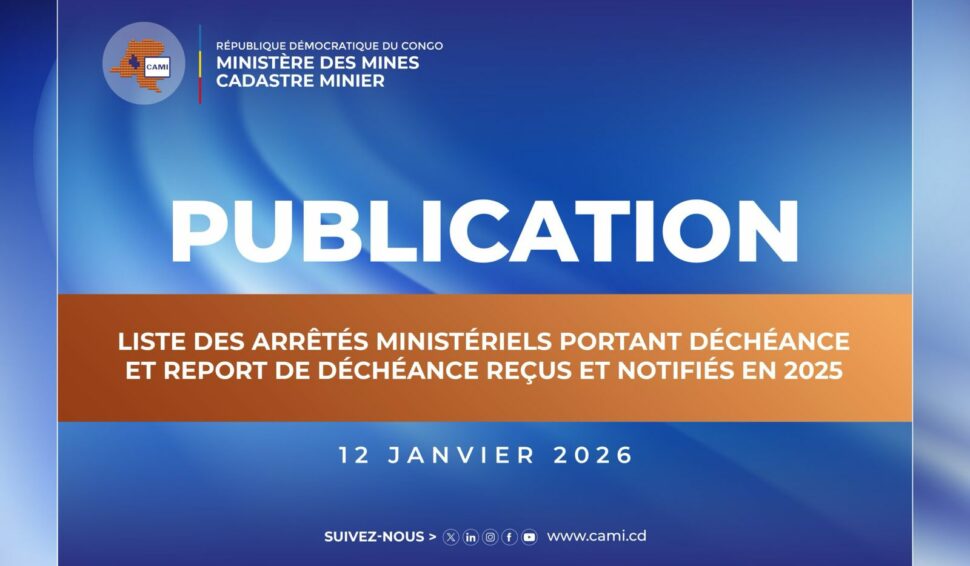
On January 9, 2026—37 days after Kinshasa signed the Strategic Partnership Agreement granting Washington preferential access to Congolese minerals—the Mining Cadastre (CAMI) revoked 45 mining permits in a single administrative stroke.
Official justification? Unpaid surface fees. Actual function? Strategic asset clearance.
The numbers tell the story CAMI won’t. Those 45 permits represent roughly 15% of the entire year’s 2024 revocations (294 total), compressed into one ministerial decree dated exactly one week after the DRC missed its contractual deadline to submit the Strategic Asset Reserve list to the U.S.-DRC Joint Steering Committee. Companies lost 26 research permits, 6 exploitation permits, and 13 artisanal concessions—all for the administratively convenient violation of non-payment, requiring no field verification and offering minimal grounds for legal challenge.
This isn’t routine tax enforcement. This is cadastral preparation for geopolitical realignment.
The Timing Kinshasa Can’t Explain
Article IV of the Strategic Partnership Agreement is unambiguous: the DRC shall provide the initial Strategic Asset Reserve list within 30 days of the agreement’s entry into force. The SPA was signed on December 4, 2025. That deadline expired January 2, 2026. As of January 19, no SAR list has been published. No ministerial statement confirms submission. No Joint Steering Committee meeting minutes exist.
But seven days after that deadline, CAMI issued mass revocations targeting companies with questionable operational status in strategically valuable zones. The revoked entities include Congo Mining Corporation (three exploitation permits), Congo Global Mining Corporation (one research permit), Cimentkat SAS (10 artisanal permits), Lugushwa Mining (two exploitation permits), and multiple shell entities with names like Investissement et Développement Immobiliers SARL—”Investment and Real Estate Development”—suggesting landholding vehicles rather than mining operators.
CAMI’s 2024 annual report shows the institution achieved a 96.39% surface fee collection rate, up from 93.85% in 2023, collecting $43 million total. The same report states that companies failing to pay undergo a formal déchéance procedure involving ministerial notification, payment deadlines, and final decrees—a process typically spanning months. Why did 45 permits suddenly reach their enforcement endpoint on the same day, one week after the SAR deadline?
Strategic Asset Reserve: The Mechanism Nobody Wants You To Understand
The SAR grants U.S. companies the right of first offer on designated cobalt, copper, coltan, and gold deposits. If a desirable mineral zone is already under permit to a Chinese company or inactive shell entity, the DRC can’t legally expropriate without compensation or lengthy administrative proceedings. But if the permit is revoked for routine violations—unpaid fees—the zone becomes an “unlicensed exploration area” eligible for SAR designation.
Unlicensed zones grant U.S. firms a three-month negotiation window, renewable once. If no U.S. proposal is accepted within nine months, “aligned persons”—EU companies, Qatari investors, DRC state entities—can bid. But never Chinese companies, explicitly excluded by the SPA’s “covered nations” provision referring to 10 U.S.C. § 4872(f)(2), which lists China, Russia, Iran, and North Korea.
China currently controls approximately 80% of the producing mining assets in the DRC. The SPA is Washington’s mechanism to challenge that dominance—not through market competition, but through right-of-first-offer backed by exceptional fiscal incentives and accelerated permitting that make Chinese bids structurally disadvantaged.
The easiest path? Revoke dormant permits held by inactive companies or Chinese-linked shells, then redesignate those zones as SAR projects. CAMI’s January 9 decrees look suspiciously like that path being executed.
The Companies That Lost (And Why It Matters)
Not all revocations are equal. Lugushwa Mining lost two exploitation permits—PE 38 and PE 2601—for unpaid surface fees rather than production failures or environmental violations. Exploitation permits represent active or near-active operations; revoking them for administrative violations instead of operational deficiencies is unusual.
La Minière du Congo forfeited PE 12717 under identical circumstances. Congo Mining Corporation lost three exploitation permits (PE 15188, 15189, 15190) simultaneously. These aren’t household names in Congolese mining—they’re cadastral placeholders, potentially holding strategic acreage without development plans.
Then there’s the cluster of six Investissement et Développement Immobiliers SARL research permits revoked together—PR 13273, 13275, 13276, 13279, 13280, 13281. A real estate development company holding mining permits? Perfect for cadastral clearing.
And Cimentkat SAS, which lost 10 artisanal permits (AECP 14753-14762) in one administrative action. Cimentkat’s name suggests cement operations, not artisanal mining—raising questions about why a cement company held a dozen artisanal permits and why all were revoked simultaneously.
The Reform Leverage Washington Holds
Article XII imposes a 12-month deadline for the DRC to amend the mining law, implementing fiscal stabilization (10-year guarantee), mandatory 90-day VAT refunds, offset mechanisms, simplified documentation, Guichet Unique (one-stop window), and a single tax authority for mining investors. Deadline: December 4, 2026.
Kinshasa has never completed major mining law reform on schedule. But here’s the leverage: if reforms aren’t enacted, U.S. investors don’t come. If investors don’t materialize, the Strategic Asset Reserve becomes symbolic. If the SAR fails, the entire agreement collapses—and Kinshasa loses security cooperation, infrastructure financing ($4 billion for Sakania-Lobito Corridor), and “strategic partner” status equivalent to Japan and South Korea.
So Kinshasa faces a choice: implement unpopular reforms threatening provincial governors’ revenue streams and Treasury cash flow, or watch the SPA die from administrative paralysis. The January 9 revocations suggest betting on implementation—clearing permits now, before the SAR list is finalized, positioning the government to move quickly once Washington’s priorities are confirmed.
The JSC Meeting That Will Confirm Everything
The first Joint Steering Committee meeting is mandated within 90 days of the SPA’s entry into force—no later than March 3, 2026. At that meeting, the JSC will review the SAR list (if submitted), discuss project proposals and offtake guidelines, monitor reform compliance, and address eligibility disputes.
If the January 9 revocations were strategic asset clearing, that JSC meeting will confirm it. Zones corresponding to revoked permits will appear on the SAR list. U.S. companies will submit right-of-first-offer proposals within three months. The DRC will accept proposals demonstrating offtake commitments to U.S. markets. CAMI will issue new permits to U.S. or “aligned” companies for the exact concessions previously held by Congo Mining Corporation, Cimentkat, Lugushwa. That’s when the pattern becomes undeniable.
The Cynical Calculus Kinshasa Won’t Admit
Here’s what this looks like from the government’s perspective: you have hundreds of dormant permits held by companies that never developed concessions, never paid fees consistently, never contributed to GDP. Some are Chinese-linked shells. Others are speculative landholdings.
A few represent genuine but failed ventures.
You also have a Strategic Partnership promising $4 billion in corridor financing, development finance for Grand Inga, security cooperation against M23, strategic partner status, and U.S. export market access. The price? Designate mineral assets for U.S. right-of-first-offer. Implement fiscal reforms within 12 months. Grant the JSC veto power over asset decisions.
So you run a cadastral purge. Revoke permits for legally defensible administrative violations. Create unlicensed exploration zones designable as SAR projects without compensating previous holders. Position yourself to deliver what Washington wants without admitting you’re clearing ground for American companies.
Is this corruption? Not technically—it’s administrative enforcement of existing regulations. Is it transparent? Absolutely not. Is it strategic asset management aligned with geopolitical realignment? That’s exactly what it is.
Strategic Clearing Disguised As Administrative Theater
Three factors confirm the January 9 revocations as SAR preparation rather than routine enforcement:
Timing: 37 days post-signature, one week post-deadline, six weeks pre-JSC.
Scale: 45 permits in one action—15% of 2024’s annual total—despite CAMI achieving 96% fee collection rate.
Justification: Non-payment of surface fees—lowest administrative threshold, minimal verification required, limited legal challenge grounds.
Kinshasa faces a strategic imperative: deliver commercially viable SAR assets or watch the SPA collapse into diplomatic theater. The easiest path is revoking dormant permits held by inactive companies and Chinese-linked shells, then redesignating zones as Strategic Asset Reserve projects with U.S. right-of-first-offer.
The 45 companies that lost permits on January 9 weren’t victims of arbitrary state predation. They were casualties of geopolitical realignment—removed to make space for American investors with preferential advantages and fiscal incentives, making Chinese competition structurally impossible.
This isn’t corruption. It’s strategic cadastral management. And when the JSC publishes its first SAR list in March, the zones will match the revoked permits almost perfectly. That’s when administrative theater becomes confirmed strategy—and CAMI’s “routine enforcement” is revealed as exactly what it was designed to be: clearing cadastral ground for Washington’s shopping list.
What This Means For Your Operations
If you’re evaluating Strategic Asset Reserve opportunities, conducting political risk due diligence on DRC mining investments, or trying to understand which permits will appear on the JSC’s SAR list in March, you need specialized SPA expertise—not generalist Africa consulting.
Ascendance Strategies provides exclusive advisory on the US-DRC Strategic Partnership Agreement: SAR opportunity assessment, cadastral risk analysis, JSC decision tracking, and reform implementation monitoring. We translate CAMI’s administrative actions into actionable investment intelligence.
Contact: [email protected] | +33 7 51 53 43 77 | ascendance-strategies.com


