
- Michael
- Updates
The National Assembly Speaker’s ratification statement did more than reassure. It confirmed the investment surface is wider than most US investors have mapped.
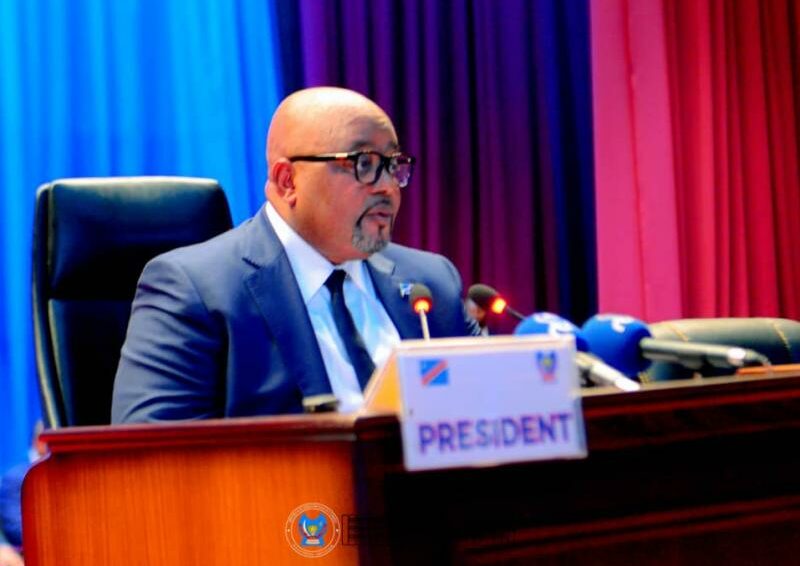
The Washington Accords entered the DRC parliamentary session on March 16, with ratification expected before the end of March. National Assembly Speaker Aimé Boji Sangara opened the session by addressing the ratification bills directly — an unusual move that signals deliberate management of the domestic political narrative around the agreement.
Three things he said matter to investors.
The sovereignty question is being handled at the top
The constitutional challenge filed in January 2026 — arguing the SPA violates DRC sovereignty over natural resources — has been the most persistent source of domestic political risk around the agreement. Boji addressed it head-on, stating that the US-DRC SPA does not undermine sovereignty or sell off mining assets, and calling on public debate to rest on facts rather than subjective interpretation.
This is the Speaker of the National Assembly, not a government minister, making this statement at the opening of the session in which the vote will occur. The political architecture behind ratification is in place. The constitutional challenge is not resolved in a legal sense — it remains an active proceeding — but its political weight has been substantially countered from the most credible domestic platform available.
The SPA framework is relevant here in a specific way. Article IV explicitly states that no DRC government authority may impose obligations, fees, or administrative procedures on SAR Projects beyond those expressly set out under DRC law. Article XVIII(6) confirms that nothing in the agreement prevents either party from entering strategic partnerships with other countries. These provisions directly counter the sovereignty argument — the DRC retains domestic legal authority and is not locked into exclusivity. Boji’s statement tracks the text of the agreement closely, suggesting the National Assembly’s legal team has done its homework.
Confidence: HIGH that ratification proceeds this session. The constitutional challenge continues to warrant monitoring, but no longer represents a blocking risk in the near term.
Non-US investors just got an explicit green light
Boji went beyond defending the SPA against sovereignty concerns. He stated explicitly that the agreement does not restrict the DRC’s openness to other international investments — and that the country remains open to all partners of good faith across mining, agriculture, energy, tourism, and telecommunications.
This is the most important sentence in the article for any non-US investor reading it. The SPAs’ preferential treatment for US and aligned persons has generated concern in European, Canadian, and Asian investor circles that the DRC is being locked into an exclusive US framework. The Speaker’s statement is a formal signal that this is not the government’s interpretation.
The SPA framework supports this reading precisely. Annex 2 defines an “aligned person” as any non-US person who is not a national or entity of a covered nation — effectively excluding only China, Russia, and a small number of sanctioned states. European, Canadian, Australian, and Japanese investors qualify as aligned persons and receive access to the SAR investment process, QSP fiscal incentives, and Lobito Corridor preferential treatment under Articles VII, VIII, and IX. Article XVIII(6) reinforces this: the agreement explicitly does not prevent either party from entering strategic partnerships with other countries. The DRC’s investment landscape is not being closed — it is being structured, with a preferential lane for US and aligned investors, and the existing lane remaining open for all others.
For law firms and advisory firms managing non-US clients with DRC exposure, this is the quote their clients need to hear — backed by the text of the agreement itself.
Confidence: HIGH on the statement. MEDIUM on implementation consistency — the JSC’s actual behavior over the coming 12 months will determine whether preferential US treatment creates practical barriers for non-US aligned investors in practice.
Grand Inga just entered the political agenda
The most consequential signal in Boji’s opening statement received no attention in the original reporting. The Speaker called on the National Assembly to receive — without delay — the Grand Inga Dam bill for examination during this same March 2026 session.
The SPA framework makes this timing significant. Article X established a dedicated Grand Inga Hydropower Project Coordination and Governance Committee with equal US-DRC representation, tasked with mobilizing capital from DFC, EXIM, multilateral development banks, and private investors. Article V designates Grand Inga as a Designated Strategic Project — meaning US persons and aligned persons hold the first right of offer for participation, financing, and supply chain roles. Article XIV(5)(c) commits the United States to mobilize development finance for transportation, energy, and infrastructure projects that involve US or aligned persons. The SPA has already built the legal and financing architecture around Grand Inga. What has been missing is the DRC’s domestic legislative track to match it. Boji’s statement is the first signal that Parliament is moving to close that gap.
No Inga bill has been formally tabled yet. This remains a political request, not a legislative action. But the direction is clear.
For energy companies, infrastructure developers, and any investor tracking DRC power sector opportunities under the SPA, this is the development to watch.
Confidence: MEDIUM — the signal matters; the action has not followed yet. Progress in the coming weeks determines whether this is genuine acceleration or political positioning.
The bottom line
The ratification is proceeding with active political management from the top of the National Assembly. The sovereignty narrative is being countered at the institutional level — and the SPA’s own text provides the legal grounding for that counter-argument. Non-US investors have an explicit parliamentary statement confirming their access is not restricted, consistent with the agreement’s definition of aligned persons. And Grand Inga has entered the political agenda in direct connection with SPA implementation, with the full legal and financing framework of Article X already in place, waiting for it.
The 12-month Article XII reform clock, which started with the March 16 session opening, now has three concurrent tracks to monitor: SPA ratification vote, fiscal reform delivery, and Grand Inga legislative progress.
Overall SPA implementation confidence: MEDIUM-HIGH. Political conditions for ratification are in place. Reform delivery and Inga progress require continued tracking.
Thank you for reading!
Ascendance Strategies tracks SPA ratification, JSC developments, and Article XII reform compliance weekly. [email protected]
Washington. Paris. Kinshasa.