
- Ascendance Team
- Deep Analysis, Updates
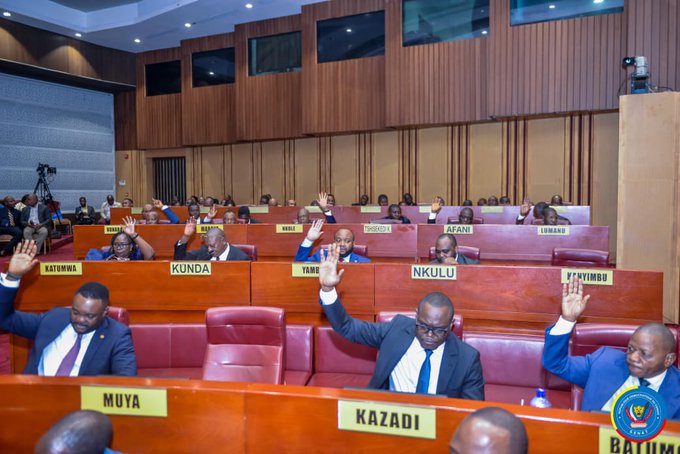
On Tuesday, 19 May, the DRC Senate unanimously adopted the two ratification laws for the Washington Accords: 76 in favor, zero abstentions, zero against.
President Jean-Michel Sama Lukonde presided.
The laws, authorizing presidential ratification of the 4 December 2025 US-DRC Strategic Partnership Agreement and the 27 June 2025 DRC-Rwanda Peace Agreement, had already cleared the National Assembly without debate on 27 April.
The constitutional cycle initiated by Prime Minister Judith Suminwa on 7 March under Articles 213-214 is complete.
President Tshisekedi now has 15 days to promulgate.
Only after promulgation, the executive act of ratification by the President via the Foreign Minister, and notification exchange do the agreements become binding under international law.
The Senate vote closes Parliament’s role; it does not bind the DRC internationally.
Signal 1: The Article XII reform clock origin date moves to June.
Until this week, the National Assembly’s 27 April adoption was the operative trigger investors used for the SPA’s 12-month structural reform deadline. The Senate vote on 19 May closes parliamentary authorization, but the SPA enters into force only upon presidential ratification and instrument deposit.
Per the DRC Constitution, Tshisekedi has 15 days from transmission to promulgate. The reform clock most likely starts in early June 2026, narrowing the window some commentators used to call early reform misses but extending the structural delivery horizon to mid-2027.
Investors who positioned around a March 2027 deadline should recalibrate.
Confidence: HIGH. Sources: ACP.cd plenary report 19 May; Senate communiqué; Primature Suminwa 7 March; DRC Constitution Articles 213-214; SPA Article XII text.
Signal 2: The 23% paradox confirms parallel-track implementation.
On 5 April, Radio Okapi reported the Washington Accords at 23% implementation eight months after the Peace Agreement’s June 2025 signing, three weeks before the Assembly’s 27 April vote and six weeks before the Senate closed parliamentary authorization.
The implication is structural: substantive operational deployment occurred before either chamber had voted. The Aligned Person framework defined in Annex 2 has been operationalized expansively through bilateral channels parallel to the Joint Steering Committee architecture.
The 19 May State Department language on Ebola response, coordinating with “U.S.-aligned companies operating in eastern DRC”, is the most recent example.
Implementation rhythm is set by the executive, not the legislature. Watch the Joint Security Coordination Mechanism (JSCM) separately from the JSC: distinct architecture, governing the Peace Agreement’s track on Rwandan disengagement, FDLR neutralization, and displaced persons return.
Confidence: HIGH. Sources: Radio Okapi, 5 April; State Department, 19 May; ACP.cd Senate vote breakdown, 19 May.
Signal 3: The Senate leadership architecture carries a structural contradiction.
The bills were routed through four mixed commissions: Foreign Relations, Defense, Security, Borders for the Peace Agreement; Environment, Sustainable Development, Natural Resources, Tourism, and the Economic, Financial, and Good Governance commission jointly for the SPA. Senator Muya Muboyayi Clément carried the plenary motion. Foreign Minister Thérèse Kayikwamba Wagner defended both texts.
Notable: Senate 2nd Vice President Norbert Basengezi Katintima, who took office on 3 April 2026, remains on the OFAC SDN list under the DRCONGO program, designated 21 March 2019 for his role as CENI Vice President during the contested December 2018 elections.
The DRC body that just unanimously authorized ratification of a strategic partnership with the United States is led, in part, by an individual whom US persons are prohibited from transacting with. President Tshisekedi’s party selected him over alternative candidates from coalition partners. The contradiction was selected, not inherited.
Confidence: HIGH. Sources: OFAC SDN list (publication date 31 December 2019, program DRCONGO); Treasury press release 21 March 2019; Senate election 3 April 2026 per Actualité.cd; USN secretariat André Mbata candidacy deposit 31 March 2026.
Parliamentary authorization crossed the Washington Accords’ constitutional threshold the same week the Bundibugyo Ebola outbreak became the framework’s first operational test. The phase from constitutional completion to the first stress test was compressed to a single week. Co-mediators (African Union, Qatar, Togo) remain engaged.
US lawmakers have introduced the Stable DRC Act to enforce compliance through sanctions if needed. Parliament has done its work.
Ratification, the executive act that binds the DRC under international law, has not.
Washington. Paris. Kinshasa.