
- Ascendance Team
- Deep Analysis, SPA Intelligence Briefs
New Compliance Exposure for the DRC Western Corridor After the Kabila SDN Listing
Ascendance Strategies, Deep Analysis — June 2026
The April 30, 2026, designation of former president Joseph Kabila to the US Treasury’s Specially Designated Nationals (SDN) list activates the OFAC 50% rule for every entity in which his beneficial ownership is 50% or more, directly or indirectly.
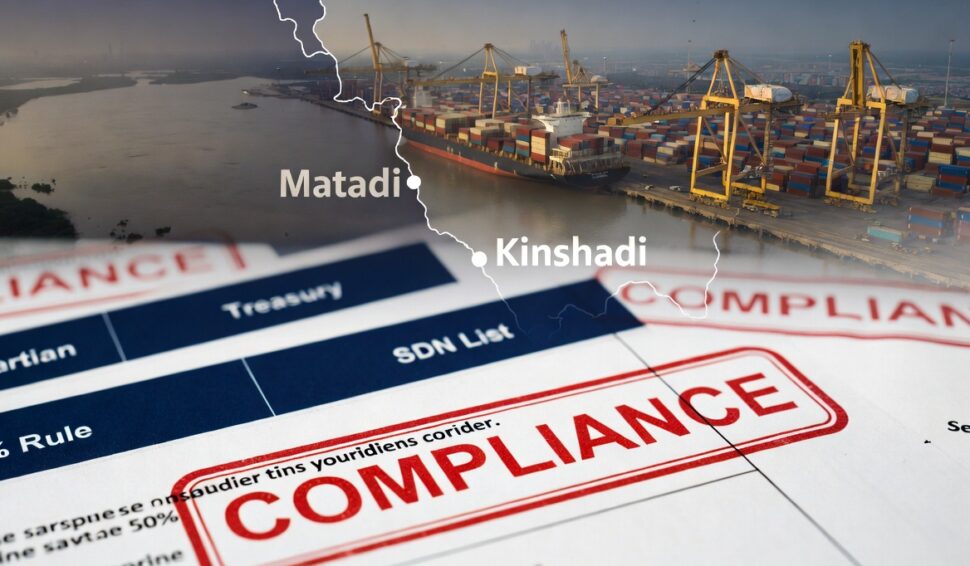
The Office of Foreign Assets Control had already opened an inquiry into possible ties between Kabila and the corporate architecture of Matadi Gateway Terminal (MGT), the principal container terminal operating the DRC’s Atlantic facade, before the listing. That enquiry is now load-bearing. Its outcome will define whether the country’s western export corridor remains usable for US-linked counterparties, including the mining operators whose copper-cobalt volumes form the commercial backbone of the US-DRC SPA framework’s Article IX commitments.
This brief sets out, in three sections, the corporate architecture investors should understand, the OFAC mechanics at work, and the strategic implications across the broader DRC-US partnership.
I. The Corporate Architecture
According to MGT’s own corporate document filed in 2020, the joint venture between International Container Terminal Services Inc. (ICTSI, Philippines, PSE: ICT) and La Société de Gestion Immobilière Lengo (SIMOBILE) is capitalized as follows: ICTSI 52%, Groupe Ledya 38% via SIMOBILE, and the Société Commerciale des Transports et des Ports (SCTP, the former ONATRA) 10% as State representation. The joint venture operating company is ICTSI DR Congo SA, incorporated in January 2014.
Groupe Ledya is a Congolese conglomerate of approximately sixteen subsidiaries founded in 1985, with operations in hydrocarbons, port handling, mining, hospitality, and food distribution. Its founder, who continues to act as group president, has been publicly associated since the mid-2000s with the political networks aligned with the Kabila presidency. This association is documented in Media Congo’s reporting on the Ango-Ango dry port inauguration in May 2018, in independent Congolese press coverage of the same period, and in the founder’s own public statements positioning the group as part of the « révolution de la modernité » project of the former administration. None of these sources establishes legal beneficial ownership by Kabila in Groupe Ledya. They establish a documented relational and political alignment, which is the antecedent question OFAC would examine in any 50% rule determination.
Confidence on corporate architecture: HIGH for the 52/38/10 split and the JV history. MEDIUM-HIGH on the political alignment of Groupe Ledya, given variable framing across sources.
II. The 50% Rule Mechanics
OFAC’s 50% rule is automatic and operates without further public notice. When a person is designated to the SDN list, any entity in which that person owns 50% or more, individually or in the aggregate with other blocked persons, is itself treated as blocked, regardless of whether the entity has been separately named. The threshold is economic, not formal. Holdings through nominees, family members, or proxy vehicles count toward the threshold if OFAC determines that the effective control is the blocked person’s.
Three operational consequences follow.
First, every counterparty subject to US jurisdiction or with US dollar clearing exposure must independently assess whether MGT, or any entity in its capital stack, crosses the 50% threshold attributable to Kabila. The absence of a public OFAC determination does not relieve the counterparty of the obligation to do its own diligence.
Second, the practical effect for any cargo shipper, mining operator, multilateral lender, or bank settling US-dollar transactions is operational caution starting at the moment the SDN listing took effect, not at the moment a determination is published. Markets reprice ambiguity. They do not wait for a resolution.
Third, the determination process itself is opaque. OFAC may take months or years to publish a position. It may publish nothing and proceed via private guidance. It may resolve the matter through corporate restructuring of MGT’s shareholding without ever stating its position publicly. Each path leaves the period of ambiguity priced into capital allocation decisions.
Confidence on 50% rule mechanics: HIGH as a matter of US sanctions law and OFAC published guidance.
III. Strategic Implications
For mining operators exporting via Matadi. Every operator routing copper-cobalt volumes through the western corridor should reassess its container terminal counterparty risk against three scenarios:
(a) OFAC declines to decide and MGT continues unaffected;
(b) OFAC determines exposure below the 50% threshold and issues a clarifying license or general guidance;
(c) OFAC determines exposure at or above the 50% threshold and the JV requires restructuring or unwinding.
Scenario (c) implies a transition period during which alternative routes — Pointe-Noire in Congo Brazzaville, Boma in DRC, or eastern routing via Lobito — absorb the volumes.
Operators should have written contingency arrangements in place by mid-2026.
For SPA Article IX implementation. The strategic value of the Sakania-Lobito corridor rises materially if the western corridor enters compliance uncertainty. The Article IX commitments on routing at least 50% of copper, 90% of zinc, and 30% of cobalt via Lobito within five years already favored the eastern corridor. The MGT exposure tilts the operational case further toward Lobito in the next 12 to 24 months. Investors structuring exposure to Lobito Atlantic Railway, Trafigura, the Lobito-Kolwezi rail extension, and complementary infrastructure should expect demand acceleration relative to baseline projections.
For US Treasury and DFC engagement under the SPA. The May 11, 2026, visit of US Treasury Deputy Assistant Secretary Wiggins to Kinshasa established the operational tempo of the SPA Article 1B energy track.
The MGT exposure adds a parallel compliance dimension: any DFC, EXIM, or multilateral first-mover commitment on DRC infrastructure must now incorporate diligence on the western corridor exposure to OFAC determinations downstream. Expect this to extend, by approximately 60 to 90 days, the timeline to the first DFC structured commitment on a DRC asset.
Confidence on strategic implications: MEDIUM-HIGH on direction, MEDIUM on the precise timing of scenarios.
What to Watch — 60 to 90 Days
Three signals will tell investors whether the corridor exposure crystallizes or resolves.
One, any OFAC public guidance, general license, or determination relating to MGT or its capital structure. Two, any voluntary restructuring announcement by ICTSI, including a partial cession of the JV shareholding or modification of the operating agreement. Three, the timing and substance of the next DFC announcement on a DRC asset, which will indicate whether the US side has integrated MGT exposure into its first-mover diligence framework.
Ascendance Strategies is monitoring these signals continuously. We will issue update notes as material developments occur.
This Deep Analysis is part of the SPA Implementation Monitoring track. For client-specific exposure assessment, retainer structuring, or asset-level recalibration, contact Ascendance Strategies directly.
Washington. Paris. Kinshasa.