
- Ascendance Team
- SPA Intelligence Briefs
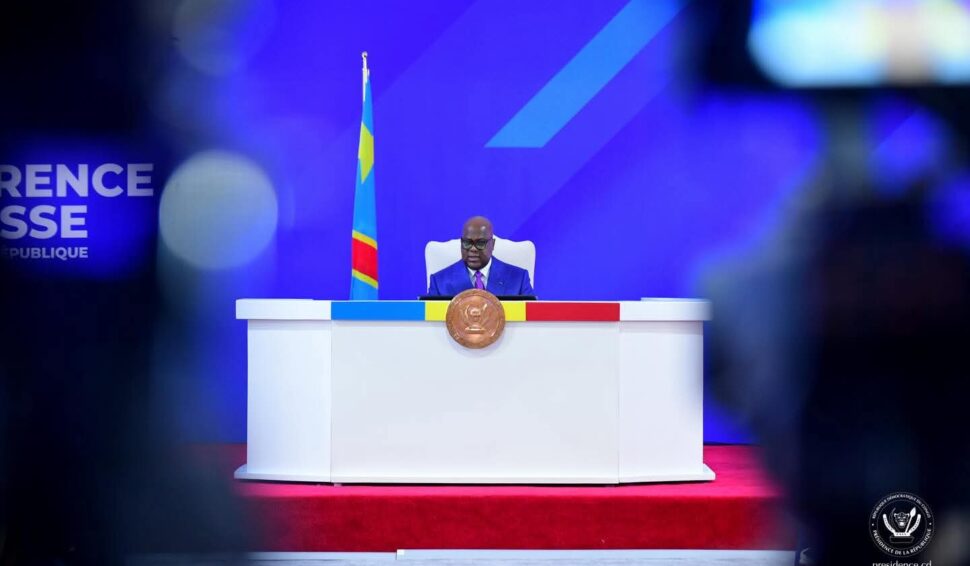
On May 6, President Tshisekedi held his first press conference since February 2024. Three hours. Broadcast nationally. The most consequential presidential communication since the SPA was signed.
He delivered the strongest official defense of the agreement yet recorded and, in the same sitting, opened the door to a third presidential term, conditioned the 2028 elections on eastern territorial liberation, and invoked 20-year UDPS party doctrine to legitimize constitutional revision.
For SPA investors: the presidential commitment is now on the record.
For SPA risk analysts: so is everything else.
The SPA defense
Tshisekedi did not mention the agreement in passing. He built it into the structural spine of the press conference. Multi-sector partnership. Minerals, infrastructure, agriculture, health, and military cooperation. Balanced and mutually beneficial. Local processing. Value addition. Jobs. He rejected the “bradage” accusation by name. He confirmed the Kabila OFAC sanctions are justified.
This is not the language of a head of state who privately doubts the agreement. For investors who priced presidential ambivalence as a risk, that risk has materially decreased as of May 6. The National Assembly adopted both ratification bills by a vote of 370-1 on April 27. They now sit before the Senate. A robust presidential defense delivered through that window is no coincidence. It is sequence management.
The third term declaration
“Je n’ai pas sollicité un troisième mandat, mais si le peuple veut que j’aie un troisième mandat, j’accepterai.”
He added: “Si les Congolais me demandent de revenir au front, je suis à leur disposition.” And: “Je serai là, dans l’ombre, prêt à servir dès qu’il ou elle aura besoin de moi.“
The rhetorical construction is deliberate. “I have not sought it” provides formal deniability. “If asked, I will accept” provides the actual political commitment. “I will be there, in the shadows,” signals continued influence regardless of outcome. He then anchored it in UDPS’s founding ideology: “En 2006, l’UDPS avait dit que si elle arrivait au pouvoir, cette constitution serait changée.” Revision is not a personal ambition. It is a party program.
The move is architecturally sophisticated.
Before Tshisekedi said it, his Sports Minister Didier Budimbu had already removed the ambiguity at a UDPS rally: “Nous allons tout droit vers un troisieme mandat, nous n’aurons pas honte.” The legislative vehicle is already built: two referendum bills, from majority deputies Ngondankoy and Mwaba, filed sixteen months apart. Majority figure Freddy Kita this week: “La Constitution n’est ni la Bible ni le Coran.”
The mechanism exists. The political will is declared. The press conference formalized what the party had already announced.
Elections conditioned on the war
The third mandate declaration was the headline. The election declaration may prove more consequential.
Tshisekedi conditioned the 2028 presidential elections on the prior liberation of occupied eastern territories. M23 holds Bukavu, Goma and other territories. The Montreux prisoner release deadline expired without delivery. The ceasefire verification mechanism has not been deployed.
The logical chain: war continues — elections delayed — constitutional revision by referendum opens the window — Tshisekedi accepts on popular demand. Each link has a Kinshasa-controlled valve.
Claudel-Andre Lubaya’s formal statement, titled “Ni mission, ni troisieme mandat,” delivers the sharpest structural contradiction: if elections cannot be organized in occupied eastern territories, how is a nationwide referendum possible in the same geography? He also notes the paradox: if Article 220 falls and term limits are removed, Joseph Kabila becomes legally eligible to run again. A revision designed to extend Tshisekedi’s mandate could legally restore his predecessor’s eligibility.
The SPA’s investment horizon is five to ten years. Every operator and institution pricing a DRC commitment must now model the scenario where the political framework is revised by referendum before 2028, with elections deferred to a date the presidency controls.
The opposition field is cleared
Tshisekedi is doing this in a landscape where his three most credible rivals have been removed from the domestic arena. Vital Kamerhe resigned as National Assembly president in September 2025 under threat of destitution. Joseph Kabila is condemned to death and OFAC SDN-listed. Moise Katumbi is in exile. The third mandate is not being attempted against a field of credible opponents. It is being attempted in their absence.
Fayulu held his press conference on May 8, presenting himself as “LE PRESIDENT”, a legitimacy proclamation. Delly Sessanga: “Les masques sont tombés.” Dr. Denis Mukwege has emerged as the most internationally credible opposition voice. Cardinal Ambongo, LUCHA, ASADHO, and Katumbi’s camp from exile have all rejected the revision. Etienne Tshisekedi, the president’s father, fought Kabila’s “glissement” from the streets. His son is now invoking the UDPS doctrine to justify the revision his father made famous for resisting.
The migrants declaration
One statement received almost no coverage. Asked about the arrangement to receive approximately 1,100 US-expelled Afghan migrants, Tshisekedi called it “un service entre partenaires.” He chose the word “service.” Civil society organizations that denounced the deal as “sous-traitance migratoire” will use that word against him. The CENCO sovereignty critique of the SPA now has a presidential source.
One analytical verdict
The press conference strengthened the SPA’s political legitimacy on one axis and complicated it on two others.
Presidential commitment: materially stronger.
Succession clarity: materially weaker.
The “service” framing of the partnership: now on the presidential record.
The SPA’s most powerful advocate has become its most complex political variable.
— END —
A new format launching Monday, May 18.
Every Monday evening, Ascendance Strategies hosts a one-hour virtual session for vetted subscribers. The session walks through the week’s intelligence brief and looks ahead at the coming week’s key events. Chatham House rules. A very small number of participants.
The first Monday session follows May 18.
To request vetting: [email protected]
Washington. Paris. Kinshasa.