
- Ascendance Team
- Competitive Intelligence, Partnership Analysis
What a week of cold outreach taught us about the gap between SPA ambition and on-the-ground reality
Part 1 of 3: The SPA Knowledge Gap Series
Last week, we reached out to fifty investors, fund managers, and mining executives who’ve publicly expressed interest in the Democratic Republic of Congo since the US-DRC Strategic Partnership Agreement was signed in December. The pitch was straightforward: Strategic Asset Reserve opportunity assessment, political risk due diligence, and ongoing analysis on governance reform implementation.
The response rate was impressive — 34%. The conversations that followed were revealing.
They want the minerals. They absolutely do not know the country.
The Enthusiasm Is Real
Make no mistake. The interest is genuine. Robert Friedland told analysts that inquiries about DRC opportunities are “nearly infinite.” The US Development Finance Corporation has issued letters of interest worth billions. At February’s Mining Indaba in Cape Town, every major panel featured breathless discussion of cobalt, copper, and the energy transition. The Strategic Partnership Agreement has achieved what two decades of development assistance could not. It made the DRC fashionable in boardrooms from Washington to Abu Dhabi to Singapore.
But fashionable is not the same as understood.
What They Asked Us
In our conversations, patterns emerged quickly. Here’s what sophisticated investors — people managing nine-figure funds — wanted to know:
“Can you help us identify which Strategic Asset Reserve assets are actually viable?” Good question. The SAR grants US investors right of first offer on high-value deposits, but many listed assets have complex ownership structures, overlapping claims, or sit in conflict zones. The CAMI mining cadaster recorded 3,165 valid mining rights across 26 provinces as of 2024 — copper-cobalt in Haut-Katanga and Lualaba, lithium in Tanganyika, coltan in North Kivu, gold in Ituri and Haut-Uélé, diamonds in Kasaï.
Navigating that web requires more than a spreadsheet. It requires understanding why assets appear on a SAR list and what happened to the last company that tried to develop them.
“What’s the timeline for preferential regulatory treatment?” The Joint Steering Committee held its inaugural meeting on February 5, 2026 — a procedural milestone, not an operational one. Implementation lags significantly behind announcements. It always does.
“How do we navigate political risk in Katanga?” They’re asking about risk mitigation after identifying opportunities, not using political analysis to inform which opportunities to pursue. In the DRC, you don’t mitigate political risk. You live inside it. And “Katanga” hasn’t been an administrative entity since 2015 — it was split into Haut-Katanga, Lualaba, Haut-Lomami, and Tanganyika. The investors didn’t know that either.
What They Didn’t Ask Us
Not one investor asked about power reliability in Lubumbashi — or anywhere else. DRC’s national electrification rate sits at 21.5%. Mining companies have built a parallel power grid of approximately 363 MW because the national grid can’t serve them. A US investor evaluating a SAR asset in Lualaba needs fundamentally different energy data than one looking at Ituri, where Kibali Gold operates a 56 MW private hydro cascade completely off the national grid, or North Kivu, where the aging Ruzizi dams run below capacity and M23 fighters have disrupted what little infrastructure exists.
Not one asked about the Manono lithium deposit in Tanganyika Province — arguably the most geopolitically significant mineral asset under the SPA — where an Australian company backed by Chinese capital is locked in ICC arbitration with the Congolese state, while a Silicon Valley startup backed by Bill Gates is trying to buy the claim, and China’s Zijin Mining plans to begin production from the northern half by mid-2026. Every US investor evaluating DRC entry should watch Manono as the leading indicator of whether the SPA framework can actually function.
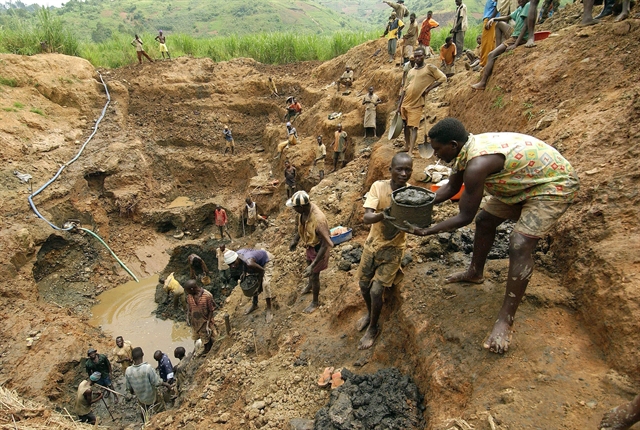
Not one asked about Rubaya, where M23 generates an estimated $800,000 per month from coltan mining — roughly 15% of global tantalum supply — in a war zone where over 200 people died in a single mine collapse and Reuters journalists had to abandon their Land Cruisers in the mud to reach the sites on motorbikes.
Not one asked whether American companies have actually secured any mining licenses since December. According to our analysis of CAMI records, they haven’t — though KoBold Metals has quietly filed twelve research permit applications across Tanganyika and Haut-Lomami provinces.
What we heard, instead, was an almost touching faith that the Strategic Partnership Agreement itself constitutes operational infrastructure. That preferential access equals actual access.
The Fund Lifecycle Problem
The most telling moment came when one fund manager asked: “If we commit now, when do you think we’d see first revenue?” We explained typical timelines — geological surveys, licensing, community engagement, infrastructure development, permitting, and construction. Seven to twelve years for a greenfield copper project. Five to seven years minimum for lithium, assuming the legal disputes are resolved.
The Lobito Corridor’s DRC segment won’t even see its international tender until April 2026, with construction starting at the earliest in late 2026.
His response: “That doesn’t work with our fund lifecycle.”
And there’s the problem. The SPA has created urgency around DRC opportunities. But mineral development operates on geological time. The Chinese invested for two decades. The one Western family that built a durable business empire in the Congo invested for a century.
American fund managers want returns within seven to ten years.
That mismatch isn’t just awkward — it’s potentially catastrophic if it leads to shortcuts, corners cut, or promises broken. The DRC has seen that movie before.
So far, based on the questions investors are asking — and not asking — we’re not optimistic.
But we remain hopeful that some will get it right.
In Part 2, we’ll examine what a century-old family business and the DRC’s most successful active mine can teach Wall Street about what “knowing the country” actually requires.
Ascendance Strategies provides Strategic Asset Reserve opportunity assessment, political risk due diligence, and governance reform tracking to organizations investing in the DRC under the SPA framework.
Contact: [email protected] | +33 7 51 53 43 77
Paris — Washington — Kinshasa