
- Ascendance Team
- Deep Analysis
Update: on 28 April 2026, the US Embassy in Kinshasa denied US funding for the Garde Minière. The IGM responded the same day with a clarification stating that “the financing mechanisms envisaged rest on diversified arrangements, associating different types of actors, and do not correspond to direct funding by any particular State.” This sequence converts the bundling thesis from announced to disputed, and makes the disbursement question the central tracking element of the architecture’s credibility. The “diversified arrangements” formulation explicitly opens the door to private operator financing, including via security contractors such as the Prince mandate already in place.
A $100 million paramilitary force, an Inspectorate dormant for thirty months, and a Trump ally who was already on the ground. The Strategic Partnership Agreement now has institutional muscle. Here is what that muscle actually looks like.
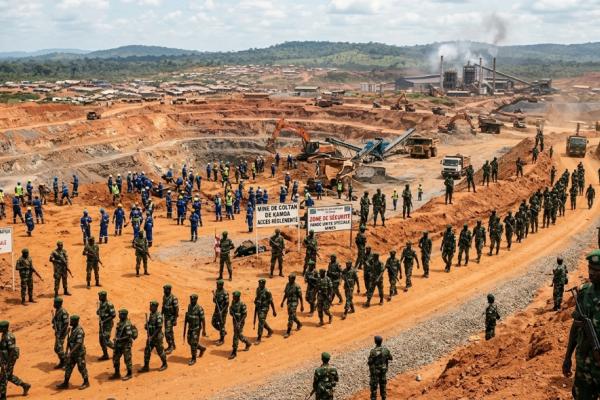
Bloomberg reported Monday what the DRC Ministry of Mines and the Inspectorate General had published over the weekend: the creation of the Garde Minière, a paramilitary force of more than twenty thousand personnel by the end of 2028, financed at one hundred million dollars under the strategic partnerships with the United States and the United Arab Emirates. Recruitment opens in May, six-month training conducted in collaboration with the Presidential Military House, first contingent of 2,500 to 3,000 deployed by December 2026. Coverage of Greater Katanga and Greater Orientale by the end of 2027. National coverage by end-2028.
The headlines treated this as another announcement. It is not. It is the keystone of an architecture that has been quietly assembling for fifteen months.
The architecture nobody mapped because the pieces were announced separately
The Inspectorate General of Mines was created by Decree 23/19 on 9 June 2023. It sat dormant for thirty months. Rafael Kabengele took office on 12 January 2026, five weeks after the Strategic Partnership Agreement was signed in Washington. The institution was not built for the US DRC SPA. It was activated by it.
The chronology runs as follows. In early 2025, before the M23 January offensive, Erik Prince signed a mandate with the DRC Ministry of Finance. Focus: Katanga. Mission: anti-smuggling and tax collection on mineral chains. The published government estimate for the Kolwezi corridor alone was forty million dollars per month in revenue losses. Prince’s team would integrate with a commodity testing and inspection firm to track production at major mines and improve revenue capture. Reuters confirmed the mandate in May 2025 and Africa Report in December confirmed Prince was still meeting Tshisekedi to discuss “back-up in eastern DRC.” The mandate did not end with the SPA signing. It was absorbed into it.
In January 2026, Kabengele took the IGM. By March, he was coordinating with General-Major Martin Malubuni, head of the Presidential Military House, on the evacuation of FARDC, Republican Guard, and PNC elements from mining sites where they had become operators rather than protectors. The Comibakat-Lualaba network was named in the ERG criminal complaint and gained institutional cover.
Then the Garde Minière announcement.
The Article III(b) connection is not generic security cooperation. It is vertical integration with a published replacement mandate.
The SPA’s security pillar has been read by most observers as a promise of US assistance to defeat M23 and stabilize the east. That reading misses the structure. Article III(b) underwrites the protection of mineral chains, which is a distinct objective from territorial security. The Garde Minière is not designed to fight M23. It is designed to secure flows.
What the architecture now contains is three operational layers, each handled by a different actor.
The extraction layer is occupied by SAR-eligible operators placed under the SPA framework. Chemaf-Virtus closed in March. Orion-Glencore is in negotiation. Copper Intelligence announced its Butembo project on 20 April with a former CIA officer on the board and a joint Congolese-Ugandan military framework cited as the security envelope.
The protection layer is now the Garde Minière, paramilitary by official designation, twenty thousand personnel by end-2028, training conducted in collaboration with the Presidential Military House, financed jointly under US and UAE strategic partnership envelopes, deployed across the geography where the extraction layer needs it. The Inspectorate’s communiqué states a third mission alongside site security and convoying: “the progressive replacement of defense force elements currently deployed in mining zones.” This is the most explicit official commitment to FARDC and Republican Guard withdrawal from mineral predation since the 2018 Mining Code.
The collection layer is Prince’s team, with its commodity testing and inspection partner, embedded in revenue tracking from the Ministry of Finance side. The team that defines what gets measured determines what gets enforced.
These three layers are complementary by design. Extraction without protection invites the disputes that have already surfaced over US-aligned permits in conflict-adjacent geographies. Protection without collection cannot prove that flows are now legitimate. Collection without protection cannot enforce its findings.
What this means for three audiences
First, operators with mining or transport exposure in covered provinces. A new institutional counterparty enters every security file. The phased deployment calendar matters: Greater Katanga and Greater Orientale by end-2027, national coverage by end-2028. Lualaba and Haut-Katanga operators have less than twenty months to establish working relationships with the force in the formation phase. Early movers will outperform peers who wait for deployment.
Second, provincial executives who built personal political economies on mining sector control. The Garde Minière is a centrally-commanded force that bypasses provincial authority. Governors who have functioned as gatekeepers for three years are about to discover that the gate is being relocated. The 21 April motion of censure against the South Kivu governor and the political vacuum in other provinces are not coincidental to the Garde Minière timing. They are part of the same recentralization.
Third, the UAE-US dynamic in DRC critical minerals.
Until April 2026, the UAE and US blocs operated parallel value chains: Dubai for gold, Lobito for copper-cobalt. The Garde Minière is the first declared joint financing of a Congolese institution that protects both chains simultaneously. If the disbursement materializes as announced, the parallel-blocs reading is finished. The two operate as a coordinated bundle, with one Trump ally personally positioned at the interface, having lived in Abu Dhabi between 2010 and 2014 with continuing UAE business links.
The bottom line
The Strategic Partnership Agreement is no longer a treaty waiting for institutional execution. The institutions are being installed. An Inspectorate created by decree thirty months ago, activated five weeks after the SPA signing, now commands a hundred-million-dollar enforcement architecture co-financed by Washington and Abu Dhabi, complemented by a private US revenue-collection team that has been operational for over a year. The first concrete materialization of Article III(b) is not in eastern conflict zones. It is in Kolwezi accounting, Kisanfu permits, and the convoying corridors between them. And the Inspectorate has published, in plain text, the intent to displace the FARDC and Republican Guard from mining sites by 2028.
What Bloomberg and the broader coverage will not say in the first wave of reporting is that the operational architecture has three layers, not one, and that the layer that determines how the other two function has been operational since early 2025. Investors pricing the US-DRC SPA as a future event are mispricing it. The architecture is being installed quarter by quarter. The disbursement of the hundred million dollars will confirm or refute the bundling thesis. The first contingent deployment in December 2026 will reveal whether the displacement of existing predation networks proceeds.
Monitor: the legal instrument creating the paramilitary status, the recruitment-based composition, and any procurement contracts naming Prince-linked entities.
The next Ascendance Intelligence note addresses the issues and dynamics of the new paramilitary force in relation to other existing security players. That note ships to subscribers only.
Subscribe at ascendance-strategies.com.
Washington. Paris. Kinshasa.